

Google LSA vs. Google Adwords | Which Is Right For You?


As a local business owner, one of your top priorities is to attract high-quality leads from your target areas.
When it comes to driving leads from the web, two of the most effective options are Google Ads and Google Local Service Ads (LSAs), also known as "Google Guaranteed".
While both platforms can boost your business's visibility, understanding their differences is key to choosing the right one for your marketing efforts.
In our experience, it makes the most sense for smaller businesses to start with Google LSA first, as it's generally less risky and easier to get leads. Smaller businesses making $250,000 to $500,000 or more in annual revenue can greatly benefit from Google LSA before running traditional Google Ads across many industries.

Why is this?

We’ll break down the key differences between Google Ads and LSAs, with a special focus on why we think you should start with LSA and when to add Google Adwords to your marketing efforts.

Local Service Ads (Google Guaranteed) Overview

Google Local Service Ads function on a pay-per-lead model.
Unlike Google Adwords, where you pay per click, Google LSA only charges you when a potential customer directly contacts your business through the ad.
The customer can contact you via phone call, email, text message, or even direct booking through an approved CRM. This makes LSAs particularly cost-effective for local businesses looking to maximize their budget with less risk involved.
Best of all, if someone contacts you through LSA and Google's system determines that they are not a lead, you will receive a credit and not be charged for the the contact.

Google LSA is specifically designed for local search and target potential customers in your immediate area. For example, if someone searches for "electrician near me," Google LSA ads will appear at the very top of the search results, even above traditional Google Ads.

This top positioning increases your business' visibility and can drive more qualified leads to your business.

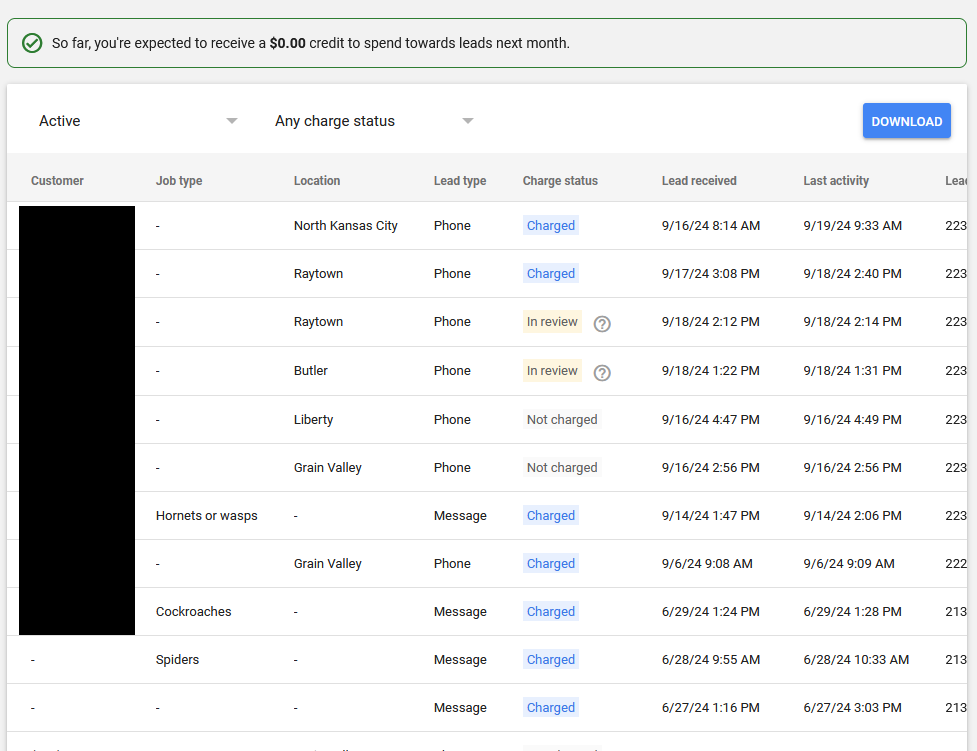
Table of job data with columns for location, charge status, and timestamps.

Another big advantage of Google LSA is earning the Google Guaranteed Badge to display on your profile and website.
To earn this badge, your business must pass a vetting process that includes background checks, insurance verification, and verified customer reviews. This badge is extremely valuable, as it builds trust with potential customers, reassuring them that your business is reliable, reputable and responsive.

Google LSA unfortunately isn't available for every industry, and in some cases, certain industries aren't available in certain cities.

Home service contractors, dentists, lawyers, real estate agents, etc are some of the industries that Google LSA is available to. You can see if your industry qualifies on the Google LSA Homepage.

Google Ads Overview

Google Adwords operates on a pay-per-click (PPC) model. This means that you only pay when someone clicks on your ad.
They allow you to take up another important spot in the search engine and give you much more control over your campaigns that Google LSAs.
One of the biggest advantages of Google Ads is the flexibility in targeting. You can bid on specific keyword themes that align with your business ("emergency plumbing near me" or "roof repair in [city]").
Your ads will appear on top of Google when potential customers search for these services using the keywords you selected or keywords that are related. 

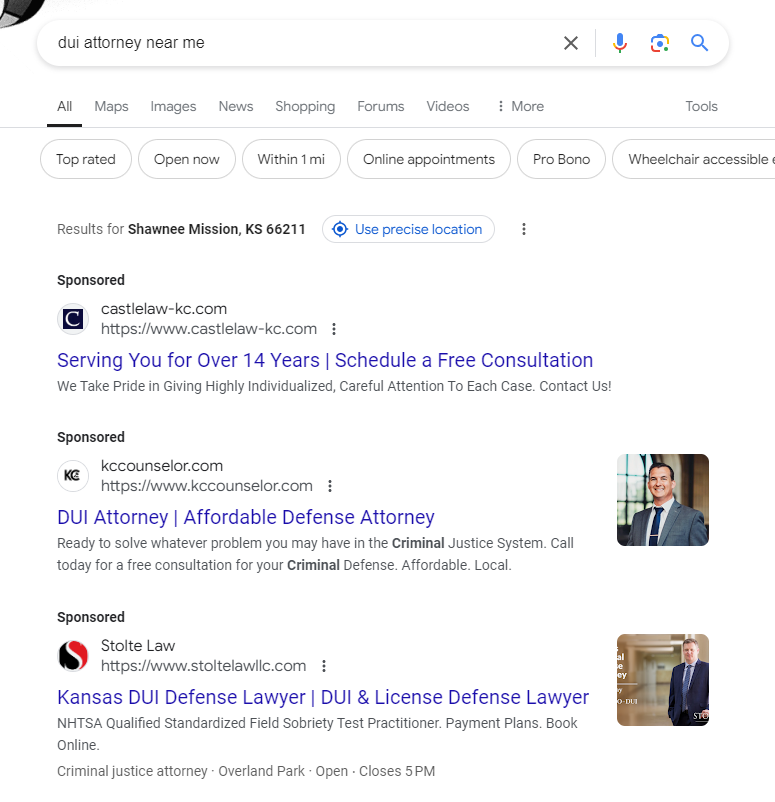
Google search results for

With Google Ads, your ad's placement is determined by a bidding competition between your competitors. If someone is willing to bid more than you (per click) for a particular keyword, it's likely they will show up above you.
Due to this, your costs could increase and will need tweaking regularly, especially in competitive industries.
Speaking of ongoing optimization, it's a must for Google Ads. The platform requires a lot more maintenance than Google LSA.
However, more maintenance means more over your budget, keywords and bidding, allowing you to target highly qualified customers and make your net more targeted and narrow.
Additionally, any business can use Google Adwords, not just approved industries like Google LSA.
When managed right, Google Ads can be one of the most effective and predictable growth platforms for your local business.

The Key Differences

To help you decide which is best for your, here's a compiled list of differences we've found between Google Ads and Google LSA:

  • Payment Models: With Google Ads, you pay per click (PPC), while Google LSA charge you only when a potential lead contacts you directly (pay-per-lead).

  • Ad Placement: Google LSA ads are positioned at the top of search results for local searches, while traditional Google Ads are served in the second position.

  • Targeting: Google Ads offers more control over audience and intent targeting, including keywords, demographics, devices and more. Google LSA, however, allows for more broad targeting for your business category, services and location.

  • Cost-Effectiveness: Google LSA ads are more cost-effective because you only pay for leads and not clicks. Google Ads, while flexible, can lead to higher costs per click and cost per lead if you’re in a competitive industry.

  • Lead Quality: Google Ads has a higher chance of bringing in the exact customer you're looking for through expanded targeting controls, whereas Google LSAs targets more broadly to people interested in your category and service only.

  • Availability: Google Ads is available to any business type or industry. Google LSAs are only available to local businesses and only specific industries.

  • Verification and Trust: Google LSA comes with the Google Guaranteed Badge, offering searchers a sense of trust and reliability. Google Ads does not have an equivalent.

Google Guaranteed badge: Green circle with white checkmark, Google logo,

Which Platform is Right For You?

If your industry is eligible, we highly recommend you start with Google LSA. If you're running Google Ads and not Google LSA, I recommend you go sign up for it and use it.
If you aren't eligible for Google LSA, or you target customers aren't always local, then we would certainly say Google Ads is the way to go.
However, a hybrid approach is certainly recommended. When you run both Google Ads and Google LSA, you'll be taking up more real estate in the Google search engine, and improve your business' chances of succeeding on the platform.
When it comes to generating qualified leads and sales from Google, your business should be taking advantage of both of these platforms, especially if you're a local business.

Orange

Looking to discover how you can improve your results from the web? Contact us to request a free consultation and we'll help you find out.

how to maximize leads from google ads
By David Jackson March 4, 2026
Join Tekkii’s free webinar to learn how to maximize leads from Google Ads and properly track calls, forms, and conversions so you know exactly what drives results.
How to actually rank in AI search cover image
By David Jackson February 20, 2026
Want to position your business for the future? AI search is on the rise and has already had a major impact on traditional SEO. If you're looking to make sure your business is still recommended in the places where customers are searching, this is the webinar for you. In this live webinar training, we'll break down exactly what you need to be ready for when it comes to ranking in AI search, and building your digital entity so that you can continually be cited as a trusted source for customers using AI to find products and services online.
your 2026 digital marketing plan
By David Jackson January 19, 2026
If you want 2026 to be a strong year for your business, you need more than random marketing tactics. You need a clear plan. This webinar walks you through how to set realistic goals, understand how buyers make decisions today, and build a strategy that actually supports your revenue targets.

Share This Article

Get the Latest

Subscribe for more digital marketing insights & tips to grow your business.