The Pin Level Method™ - Local SEO for Multi-Location Practices
Your flagship location pulls in 70% of new calls. The other locations? They're limping along, maybe breaking even, but definitely not paying for themselves the way you projected when you signed those leases.
Sound familiar?
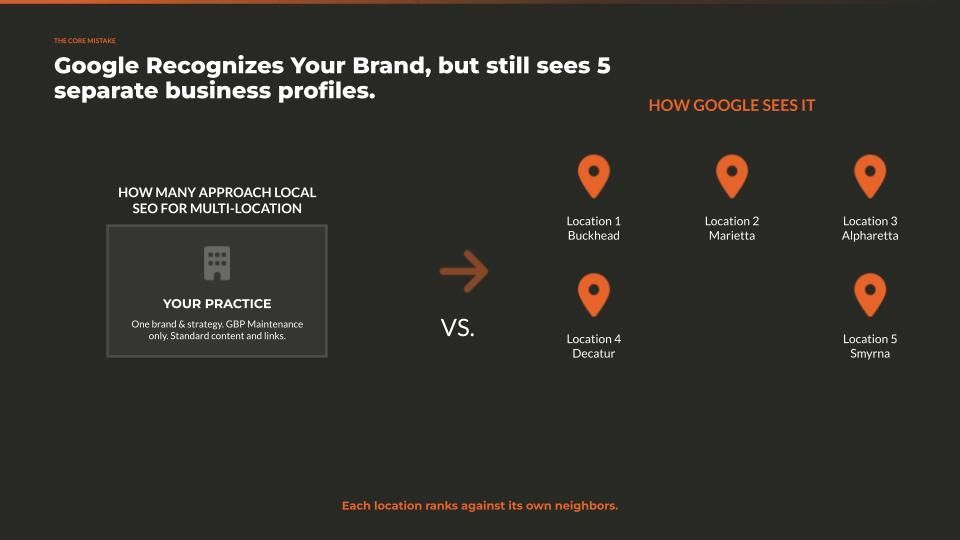
Here's what most practice owners miss: Google doesn't grade your brand. It grades each location in Google maps separately. That third location in the next suburb over isn't underperforming because the neighborhood is bad or the staff is new. It's underperforming because it's being treated like every other location.
Multi-Location SEO Is a Different Game
Most practices treat their locations the same way they treat their primary. They write blogs for the brand. They build links to the homepage. They optimize "the website."
That works for one location. It does not work for five. Each Google Business Profile has its own ranking signals:
- Different proximity
- Different competitors
- Different review velocity
- Different photo coverage
Two locations under the same brand can have wildly different scores, and the brand-level work you're paying for is barely moving the needle on the weaker ones.
Google ranks local results on three signals: proximity, relevance, and authority. These are the same fundamentals you've heard about a hundred times. What changes with multiple locations is how those signals get distributed, and which ones travel between locations versus stay locked to one address.

Proximity: You Can't Fake This One
When you put an address on your Google Business Profile, that's your ranking radius. For most businesses, you're looking at about an 8 to 10 mile range across.
For a visual, draw a square around your location with about 5 miles in each direction. Anyone searching outside that square? You're essentially invisible to them unless they type your brand name directly.
This is heavily based on competition levels and the industry, but in 99% of cases, this holds true.
This is why opening a second location matters strategically, but it's also why putting two locations too close together is a waste. You'll just compete with yourself.
Relevance: Partially Shared
Relevance is where the work happens. It comes from your website content, your reviews, your photos, your Google Business Profile posts, and how well all of it matches what people are searching.
Quick gut-check on photos: have you ever searched for "burgers" or "salad" near you? Notice how the top results show a picture of exactly what you searched for? Google is matching photos to query intent. If your competitor has a photo of teeth cleaning and you don't, they win that search even if your reviews are better and they're a worse practice.
Service coverage is the other piece. You need one page per service on your website. Not a services page with bullet points. One page per service, and ideally one page per service per city you operate in. The location-specific signals have to actually exist somewhere for Google to find them.
Authority: Mostly Shared, But Local Matters
Authority does pass between locations on the same domain. A new location tied into a strong existing site doesn't start from zero. We recently got an 8th location ranking in the top three for relevant keywords inside a month because the domain authority was already there.
But local authority is where the per-pin work shows up. Citations, chamber of commerce memberships, neighborhood blog mentions, local news coverage, it all helps tremendously.
How much authority you need depends on your market. A rural location might rank well with three to five solid local references. An urban location in a competitive metro might need fifty. There's no universal number, which is exactly why scoring locations individually matters.

What Multi-Location SEO Is Actually Worth
We've seen typical 3-location practices sitting on $200,000 to over $1,000,000 in unrealized annual revenue, just from non-flagship locations underperforming on local search.
That's not a projection or a sales pitch number. That's what shows up when you run the math on call volume, conversion rates, and average patient value across pins that should be performing equally.
If you've got three locations and two of them are quietly losing the maps battle, you're not losing a little. You're losing the equivalent of a full second practice.
Start With the Score
Before you do anything else, find out where your locations actually stands.
Not your brand. Each location.
We built a free tool called the Pin Parity Score that does exactly this. You give it a Google Maps location, and it scores that pin from 0 to 100 based on the same factors we use internally.
It looks at your competitors in the actual ranking radius, your website coverage, your local pack position, and the signals that drive each. Takes about two to three minutes. No call required, no credit card.
Run it on your flagship first. Then run it on your weakest location. The gap between those two scores is usually where the real story is.
You can run yours at tekkii.com/score
Looking to discover how you can improve your results from the web? Contact us to request a free consultation and we'll help you find out.


Get the Latest
Subscribe for more digital marketing insights & tips to grow your business.